 By
By Solar Eclipse This Week: What You Need to Know
Skywatchers are preparing for another spectacular solar eclipse, giving people around the world an opportunity to witness one of nature’s most striking astronomical events.
A solar eclipse happens when the Moon moves between the Earth and the Sun. Depending on the alignment of the three bodies, the Moon can partially or completely block the Sun from view.
This week’s event is expected to attract attention from astronomy fans, photographers and casual observers. However, watching a solar eclipse requires proper preparation because looking directly at the Sun can cause serious and permanent damage to the eyes.
Knowing when the eclipse happens is important, but understanding solar eclipse safety is even more important.
What Is a Solar Eclipse?
A solar eclipse occurs when the Moon passes between Earth and the Sun and blocks some or all of the Sun’s light.
There are several types of solar eclipses. A total solar eclipse occurs when the Moon completely covers the visible disk of the Sun. A partial eclipse happens when only part of the Sun is covered.
An annular eclipse occurs when the Moon appears slightly smaller than the Sun in the sky. This leaves a bright ring of sunlight around the Moon.
The exact appearance of an eclipse depends on where an observer is located on Earth.
This is why some people may see a significant partial eclipse while others may see little or nothing at all.
When Is the Solar Eclipse?
The exact solar eclipse time depends on the observer’s location.
The eclipse begins, reaches its maximum and ends at different times across different parts of the world. Weather conditions also play an important role because clouds can prevent viewers from seeing the event.
Anyone planning to watch should check reliable astronomical information for their exact city or region rather than relying on a single worldwide time.
For the best experience, viewers should also prepare before the eclipse begins. Finding a location with a clear view of the sky can make a major difference.
Why Is It Dangerous to Look Directly at the Sun?
The biggest risk associated with a solar eclipse is eye damage.
The Sun produces extremely intense visible, ultraviolet and infrared radiation. Looking directly at it can damage the retina, the light-sensitive tissue at the back of the eye.
This condition is often referred to as solar retinopathy.
One of the dangerous aspects of solar eye damage is that it may not hurt immediately. The retina does not have pain receptors, so a person may not realize that an injury is occurring.
Symptoms can appear later and may include blurred vision, blind spots, distorted vision or changes in colour perception.
In serious cases, damage can be permanent.
That is why ordinary sunglasses are not enough for solar eclipse viewing.
How to Watch a Solar Eclipse Safely
The safest approach is to use proper solar eclipse glasses or handheld solar viewers that meet the relevant international safety standard.
These products are specially designed to reduce sunlight to a safe viewing level.
Regular sunglasses, even very dark ones, should never be used as a replacement.
The same applies to homemade filters, photographic filters that are not specifically designed for solar viewing and other improvised methods.
If you are using eclipse glasses, inspect them before use. Do not use them if they are damaged, scratched, torn or otherwise compromised.
Put them on before looking toward the Sun and follow the manufacturer’s instructions.
What About Cameras and Telescopes?
Special care is also needed when using cameras, binoculars or telescopes.
Looking at the Sun through magnifying optical equipment without an appropriate solar filter can be particularly dangerous because the equipment concentrates sunlight.
A normal camera lens filter or ordinary sunglasses should not be placed over the eyepiece as a substitute for a proper solar filter.
Anyone planning to photograph the eclipse should use equipment and filters specifically designed for solar photography.
The safest option for beginners is often to enjoy the eclipse without complicated photographic equipment.
Can Children Watch the Solar Eclipse?
Yes, children can enjoy a solar eclipse, but they need close supervision.
Children may not understand how quickly staring at the Sun can cause eye damage. Parents and teachers should explain that the Sun must never be viewed directly without proper protection.
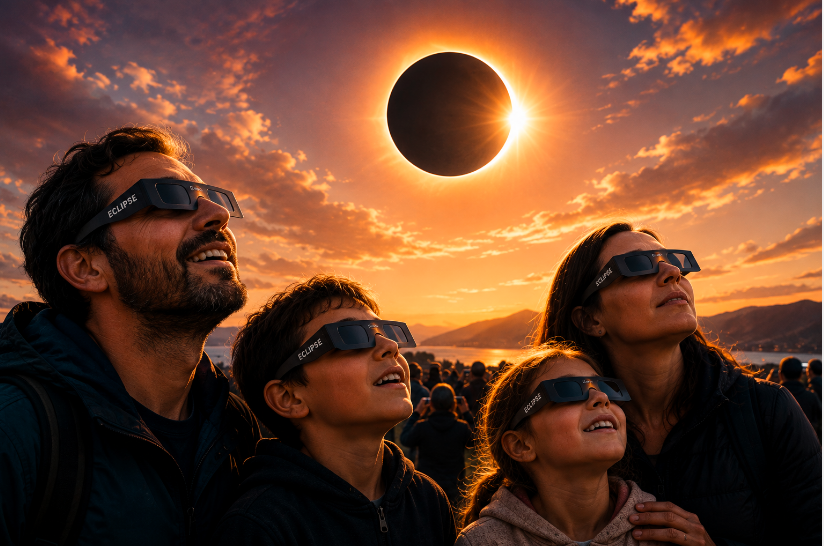
Certified eclipse viewers can allow children to participate safely when used correctly.
Adults should check that children are wearing the viewers properly and are not removing them while looking toward the Sun.
An eclipse can be an excellent educational opportunity. Parents can explain how the Moon, Earth and Sun move in relation to one another and why eclipses do not happen every month.
What If You Do Not Have Eclipse Glasses?
If you do not have proper solar viewing equipment, you can still experience an eclipse indirectly.
A simple pinhole projection method can project an image of the partially eclipsed Sun onto a surface without requiring you to look directly at the Sun.
Another option is to watch a live broadcast from a reputable astronomy organization or observatory.
Indirect viewing is much safer than attempting to look through ordinary sunglasses or homemade filters.
The key rule is simple: never look directly at the Sun through an unfiltered camera, telescope or binoculars.
Common Solar Eclipse Safety Mistakes
Many eye injuries happen because people underestimate the brightness of the Sun.
One common mistake is assuming that normal sunglasses provide enough protection. They do not.
Another mistake is briefly looking at the Sun because it appears darker during an eclipse. Even when part of the Sun is covered, the remaining visible sunlight can still be intense enough to cause retinal injury.
People should also avoid using damaged eclipse glasses or products from unknown sources that do not provide appropriate safety information.
When buying eclipse viewers, check the product information and make sure it is designed specifically for direct solar viewing.
Why Solar Eclipses Are So Special
Solar eclipses are relatively rare experiences from any particular location.
The Moon’s orbit around Earth is tilted compared with Earth’s orbit around the Sun. Because of this geometry, the three bodies do not line up perfectly every month.
When the alignment is right, however, the Moon’s shadow crosses part of Earth’s surface.
A total solar eclipse is particularly spectacular because daylight can briefly become noticeably darker, temperatures may fall and the Sun’s outer atmosphere, known as the corona, can become visible during totality.
A partial eclipse is also an impressive sight when viewed safely.
Enjoy the Eclipse — Safely
This week’s solar eclipse offers skywatchers another chance to experience a remarkable event in the night sky—or, more accurately, the daytime sky.
But the excitement should never come at the expense of eye safety.
Use proper solar viewing equipment, follow safety instructions and never rely on ordinary sunglasses.
If you cannot obtain safe viewing equipment, use an indirect projection method or watch the eclipse through a trusted live broadcast.
For families, schools and astronomy enthusiasts, an eclipse can be both beautiful and educational.
The most important thing to remember is simple: protect your eyes first, then enjoy the view.