 By
By SaaS & Tech Tools in Ireland:Essential Solutions for Modern Businesses
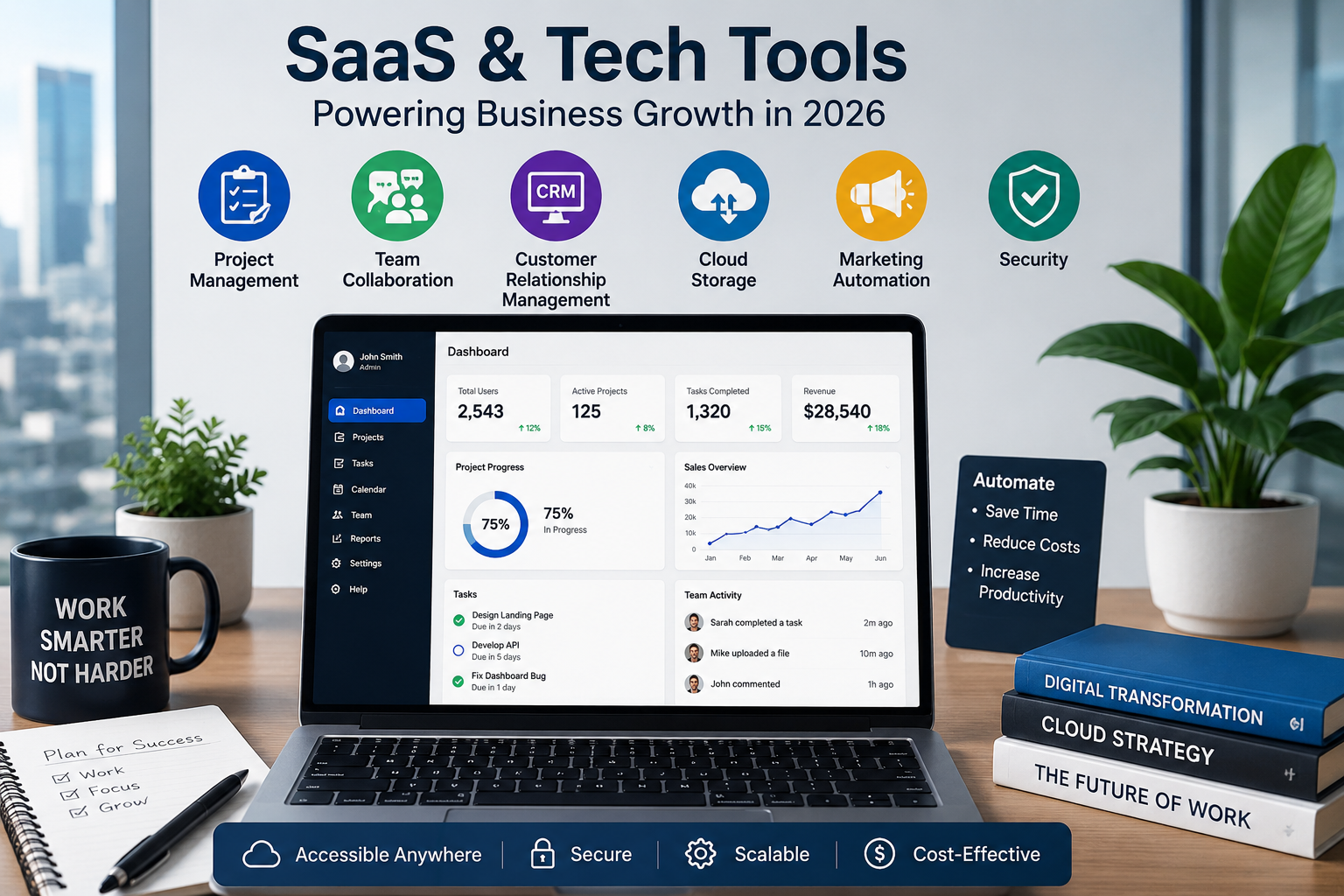
Technology has become an important part of how businesses operate, communicate with customers and manage everyday tasks. From accounting and customer relationship management to project management and cybersecurity, companies can now use a wide range of cloud-based applications without maintaining all of their own software infrastructure.
This is where SaaS tools Ireland businesses can use become particularly useful.
SaaS stands for Software as a Service. Instead of purchasing traditional software and installing it permanently on individual computers, users generally access SaaS applications through the internet, often through a subscription.
For Irish businesses, SaaS can support remote working, collaboration, customer management, financial administration and many other activities.
This guide explains the main categories of SaaS and technology tools and what businesses should consider before choosing them.
What Is SaaS?
Software as a Service (SaaS) is a software delivery model where applications are hosted by a provider and accessed by customers through the internet.
Instead of managing servers and software installations themselves, businesses can generally access the application through a web browser or dedicated app.
Common examples include:
- Customer relationship management platforms
- Accounting software
- Project management applications
- Communication and collaboration tools
- Cloud storage
- Cybersecurity services
- Marketing platforms
The SaaS model has become particularly relevant as businesses increasingly rely on cloud technology and distributed teams.
For smaller companies, cloud-based applications can also provide access to sophisticated business software without requiring the same level of internal IT infrastructure as traditional systems.
5 Essential SaaS & Tech Tool Categories in Ireland
1. Productivity and Project Management Tools
Managing tasks, deadlines and team communication can become difficult as a business grows.
Productivity and project-management software can help teams organise work, assign responsibilities and monitor progress.
These tools may provide features such as task management, calendars, shared documents, notifications and workflow tracking.
For Irish businesses with hybrid or remote employees, cloud-based collaboration can be particularly useful because team members can access information from different locations.
However, businesses should avoid subscribing to too many overlapping tools.
For example, if a company already has a platform that provides task management and team communication, adding several separate applications may create unnecessary complexity.
The goal should be to create a simple technology environment where employees know which platform to use for each task.
2. Accounting and Financial Software
Accounting is another important area where businesses can benefit from SaaS.
Cloud accounting software can help companies manage invoices, expenses, financial records and other administrative tasks.
For Irish businesses, it is particularly important to check whether accounting software supports the country’s relevant tax and reporting requirements.
Revenue provides information about ROS (Revenue Online Service), which allows businesses and individuals to access a range of Revenue services online. Businesses should therefore consider how their chosen financial software fits into their wider accounting and tax processes.
A good accounting system can also reduce repetitive administrative work and make financial information easier to access.
However, software should support—not replace—appropriate professional accounting advice when a business needs specialist assistance.
3. CRM and Customer Management Tools
Customer relationship management, commonly called CRM, is another major category of SaaS.
A CRM system can help businesses organise customer information, track interactions and manage sales activities.
Instead of keeping customer details across spreadsheets, emails and separate documents, a CRM can provide a centralised system for managing customer-related information.
Depending on the platform, features may include:
- Customer records
- Sales pipelines
- Email integration
- Marketing automation
- Customer support
- Reporting and analytics
For growing Irish businesses, a CRM can make it easier to maintain consistent customer information as the number of customers increases.
However, companies should carefully consider data protection requirements when storing customer information.
4. Cybersecurity and Data Protection Tools
As businesses become more dependent on digital technology, cybersecurity becomes increasingly important.
SaaS applications can hold sensitive business information, customer records and financial data. A security problem can therefore affect both the business and its customers.
The National Cyber Security Centre (NCSC) Ireland provides cybersecurity guidance for organisations and businesses, including information about protecting systems and responding to cyber threats.
Businesses should consider security features when evaluating technology providers.
Depending on the service, these may include multi-factor authentication, encryption, access controls, backups, security monitoring and account-management features.
Cybersecurity should not be treated as something that is only relevant to large companies. Smaller businesses can also hold valuable information and should establish sensible security practices.
5. Communication and Collaboration Platforms
Communication tools have become essential for modern businesses.
Email remains important, but companies may also use cloud-based messaging, video conferencing, document collaboration and file-sharing platforms.
These tools can help employees communicate without relying on everyone being physically present in the same office.
For businesses operating across Ireland or working with European and international clients, online collaboration can also make communication easier across locations.
The most effective technology setup is usually one where employees understand how and when to use each communication channel.
Too many overlapping communication platforms can make it harder to find information rather than easier.
Why Are SaaS Tools Important for Irish Businesses?
The biggest advantage of SaaS is accessibility.
Because applications are generally hosted online, employees can often access them from different devices and locations, subject to the provider’s terms and security controls.
SaaS can also make software updates easier because the provider manages much of the underlying infrastructure.
For small and medium-sized businesses, this can reduce the need to maintain extensive internal software infrastructure.
Another advantage is scalability.
A business can potentially add or remove users as its requirements change, depending on the pricing model of the provider.
However, SaaS is not automatically the best solution for every business.
Subscription costs can accumulate over time, and companies may become dependent on specific providers.
That makes vendor selection important.
SaaS and GDPR in Ireland
Data protection is an important consideration when selecting SaaS tools Ireland businesses use.
Ireland is subject to the EU General Data Protection Regulation, commonly known as GDPR.
The Data Protection Commission (DPC) is Ireland’s supervisory authority for data protection and provides guidance for organisations processing personal data.
If a SaaS platform processes personal information on behalf of a business, the business should understand how that data is collected, stored and processed.
Before selecting software, businesses should examine the provider’s privacy documentation, security measures, data-processing arrangements and relevant contractual terms.
It is also important to understand where data is stored and whether information is transferred outside the European Economic Area.
The exact obligations depend on the circumstances, so businesses handling significant amounts of personal data may need professional data-protection advice.
How to Choose the Right SaaS Tools
Choosing software based solely on how many features it offers can lead to unnecessary spending.
Instead, businesses should start by identifying the actual problem they want the software to solve.
For example, a company struggling with customer follow-ups may need a CRM, while a company struggling with project organisation may benefit more from project-management software.
Consider the following before subscribing:
Cost: Check the monthly or annual subscription and whether prices change as users increase.
Features: Make sure the software provides the functions your business actually needs.
Security: Review authentication, encryption, access controls and other relevant security measures.
Integrations: Check whether the software works with your existing systems.
Scalability: Consider whether the platform can support your business as it grows.
Support: Look at the provider’s customer-support options and availability.
Data: Understand how your business data is stored, processed and exported.
A short trial can also be useful before committing to a long-term subscription.
SaaS Tools for Small Businesses in Ireland
Small businesses often have different requirements from large organisations.
A small company may not need a complicated enterprise technology stack. In many cases, a combination of accounting, communication, CRM, cloud storage and cybersecurity tools may be enough.
The key is to avoid paying for features that employees rarely use.
Business owners should also consider the time required to train staff.
A powerful application that employees find difficult to use may create more problems than it solves.
Simple, well-integrated software can sometimes be more useful than a large collection of specialised applications.
SaaS and Irish Government Digital Services
Irish businesses also interact with government digital services.
Revenue’s online services, for example, allow users to manage various tax-related activities digitally.
Businesses should therefore consider their technology ecosystem as a whole.
The objective is not simply to buy more software. It is to create systems that allow employees to complete work efficiently while maintaining appropriate security and compliance.
SaaS Tools and the European Market
Ireland is part of the European Union’s digital market, meaning businesses operating in Ireland may also work with customers and suppliers throughout Europe.
This makes issues such as GDPR, cross-border data processing and European digital regulations relevant to some SaaS users.
The European Commission’s Digital Strategy provides information about the EU’s broader approach to digital transformation, technology and online services.
Irish businesses expanding into other European markets should therefore consider whether their technology systems can support additional languages, currencies, regulations and customers.
Frequently Asked Questions About SaaS Tools in Ireland
What does SaaS mean?
SaaS stands for Software as a Service. It is a software delivery model where applications are generally hosted by a provider and accessed over the internet.
What are SaaS tools used for?
SaaS tools can be used for accounting, CRM, project management, communication, marketing, cloud storage, cybersecurity and many other business activities.
Are SaaS tools suitable for small businesses?
Yes. SaaS can be particularly useful for small businesses because many cloud applications can be accessed without maintaining extensive internal IT infrastructure.
What should Irish businesses check before choosing SaaS software?
Businesses should consider cost, features, security, integrations, scalability, customer support, data processing and relevant GDPR requirements.
Do SaaS companies need to follow GDPR?
GDPR applies to organisations processing personal data in circumstances covered by the regulation. Whether and how specific obligations apply depends on the organisation and its processing activities. The Irish Data Protection Commission provides guidance on data-protection responsibilities.
Is SaaS the same as cloud computing?
Not exactly. SaaS is one type of cloud service. Cloud computing is a broader concept that can include software, infrastructure and platforms delivered through cloud environments.
Final Thoughts
SaaS tools Ireland businesses use can support everything from accounting and customer management to collaboration and cybersecurity.
The most important point is that technology should solve a genuine business problem rather than simply add another subscription.
Before choosing software, compare its cost, features, security, integrations and data-handling practices. Businesses should also consider how the technology will fit into their existing systems as the company grows.
For Irish organisations, data protection and cybersecurity deserve particular attention. Official resources from the Data Protection Commission, National Cyber Security Centre and Revenue can provide useful guidance alongside information supplied by individual software providers.
With a well-planned technology strategy, SaaS can help Irish businesses build more flexible, connected and efficient digital operations.