 By
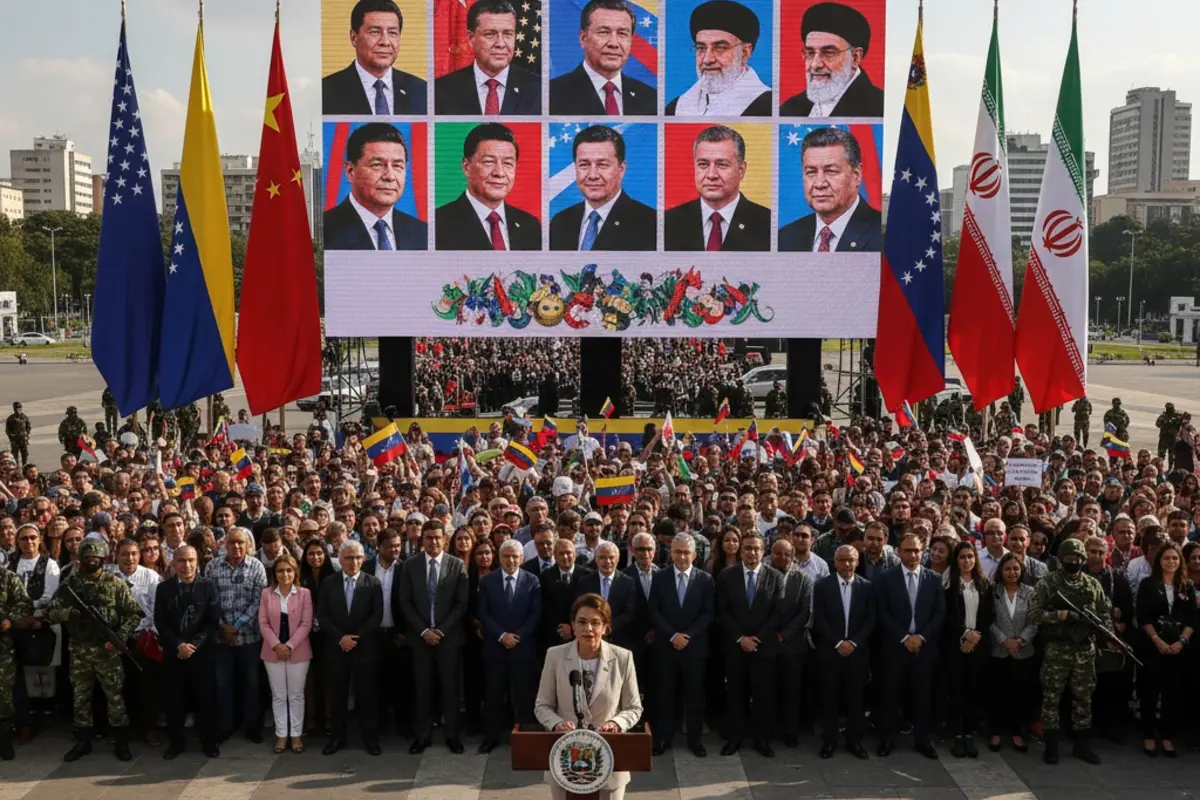
By Venezuela is at the center of a major global crisis. A dramatic military operation carried out by the United States has captured Venezuelan President Nicolás Maduro and his wife. In response, Venezuela’s Supreme Court named Vice President Delcy Rodríguez as the new interim leader.
China and Iran have reacted strongly. They are calling on the United States to release Maduro and return him to Venezuelan control. These events are unfolding fast and have sparked worldwide debate about law, power, and international order.
This article explains the background, the key players, world reactions, and what this shift in leadership means for Venezuela and the global community.
What Happened in Venezuela?
Early in January 2026, the United States launched a large military action in Venezuela. During the operation, U.S. forces captured President Nicolás Maduro and his wife. Maduro was then taken to a U.S. detention facility to face charges related to drug trafficking and other serious accusations.
This strike was unusual. It was not a typical military conflict between armies. Instead, it involved special forces entering Venezuela’s capital, Caracas, and removing the president from power. Texans, Venezuelans, and people around the world woke up to news of this extraordinary event.
The United States declared it would temporarily manage Venezuela, at least until a stable process could be set up. The U.S. said its goal was to restore democratic governance and end drug trafficking linked to Venezuela.
Delcy Rodríguez: Venezuela’s New Leader
After Maduro’s capture, Venezuela’s Supreme Court acted quickly. It named Delcy Rodríguez, the country’s vice president, as acting president. Rodríguez takes over most presidential powers as permitted by Venezuela’s constitution when the president cannot carry out duties.
Rodríguez is not new to Venezuelan politics. She has been a long-time ally of both Hugo Chávez and Maduro. For many years, she worked as foreign minister, vice president, and in other senior government roles. She is known for her strong support of Venezuelan sovereignty and socialist policies.
However, not everyone agrees she is a legitimate leader. Some foreign leaders, including U.S. officials, say she lacks independent authority. Yet within Venezuela, Rodríguez has key backing from the Supreme Court and parts of the military.
Rodríguez has stated that Maduro remains the true president and that she is only managing affairs temporarily. She described U.S. military action as an “illegal kidnapping” and a violation of Venezuela’s sovereignty.
China’s Response: Demand for Maduro’s Release
China has reacted strongly to the events in Venezuela. Chinese leaders called on the United States to release President Maduro immediately and return him to Venezuelan jurisdiction. China described the capture as a clear breach of international law and sovereign rights.
China’s foreign ministry demanded that the U.S. ensure the safety and release of both Maduro and his wife. It also urged the U.S. to stop attempts to topple the Venezuelan government through force or political pressure.
Chinese officials stressed that no country should act as a global judge or police. They argued that every state must respect international law and each other’s independence. China also called for diplomatic dialogue instead of military force.
This response shows that China is deeply concerned about what the U.S. action might mean for global norms and power balances.
Iran’s Reaction: Condemning the U.S. Operation
Iran has also joined China in criticizing the U.S. military action. Iranian leaders said that Venezuela has the right to defend itself, and that the U.S. move was provocative and unjustified. They said the United States violated the United Nations Charter and basic norms of international relations.
Iran did not directly focus on Maduro’s capture, but it did pressure the U.S. government to return Maduro to Venezuela. Iranian officials also called for peaceful solutions and respect for state sovereignty.
This aligns Iran with China and many other countries that oppose foreign intervention without United Nations approval. It also highlights a broader global split over how to deal with Venezuela’s crisis.
Reactions from Other Countries
Russia and Other Allies
Russia publicly condemned the U.S. actions as “armed aggression” against an ally. Russian leaders called for restraint and stressed the need for diplomatic talks. They also highlighted rising regional tensions and the risk of wider conflict.
Other countries in Latin America and around the world have also weighed in. Many have called for discussions to take place through reliable international platforms rather than unilateral military action.
United Nations and Diplomats
The United Nations Secretary-General expressed concern. He highlighted that international law must be upheld and that nations should seek peaceful and lawful solutions. The U.N. Security Council is expected to meet to discuss the crisis and its broader impact.
Some European leaders warned that such military actions risk destabilizing global order if they become accepted practice without clear legal backing.
The United States’ Position
The U.S. government argues its actions are lawful and necessary to address drug trafficking networks linked to Venezuela. It insists that Maduro’s government was corrupt and harmful to democratic norms.
U.S. leaders also said they are willing to engage with Rodríguez’s interim government and find a path forward. They claim this may lead to democratic elections and a peaceful transition.
However, critics within the U.S. and abroad argue that removing a sitting president by force, even for serious criminal charges, raises legal and ethical questions.
Delcy Rodríguez’s Statements and Plans
Rodríguez has balanced her responses in recent statements. She has strongly condemned the U.S. operation and demanded Maduro’s release. At the same time, she has said she is open to working with other countries to restore peace and stability in Venezuela.
She formed a special commission to negotiate Maduro’s return. This group includes key Venezuelan political figures and aims to resolve the crisis through talks and lawful means.
Rodríguez has also called for a balanced and respectful relationship with the United States, but without surrendering Venezuela’s independence or sovereignty.
Within Venezuela, she faces enormous pressure. Many citizens support Maduro and call for his immediate return. Others are anxious about the future and hope for a peaceful resolution.
The Question of Legitimacy
The legitimacy of Rodríguez’s leadership is debated. Some argue the Supreme Court’s decision is valid under Venezuela’s constitution. Others, including foreign leaders, question whether Rodríguez can rule effectively without broad popular support or free elections.
In the eyes of U.S. officials and some international voices, Rodríguez is not a legitimate president. They argue that true leadership should come from a democratic process, not appointments by courts or foreign influence.
This debate highlights deeper issues of how leaders gain and keep power, especially in times of crisis.
Impact on Venezuela’s People
The political crisis in Venezuela has major effects on ordinary citizens. Many Venezuelans are already dealing with deep economic challenges, shortages, and mass migration due to years of internal conflict.
With these dramatic events, uncertainty has increased. Some people fear rising tension and conflict. Others hope that new leadership and international attention may open the door for solutions.
The economy, especially oil production, remains a key concern. Venezuela has some of the largest oil reserves in the world. Decisions about how those resources are managed will shape the country’s future.
Global Implications
The capture of Maduro and the rise of Rodríguez has shaken global politics. It has raised questions about how far one country can go in using military force to change another government.
The reactions by China and Iran show that major powers are watching closely. They view this event as a test of international rules and respect for sovereignty.
If the situation leads to long-term conflict, it could affect regions far beyond Latin America. Economic ties, military alliances, and diplomatic relations are all in flux.
What Comes Next?
The coming days and weeks are critical.
- United Nations talks are expected to continue.
- International pressure on the United States may grow.
- Negotiations for Maduro’s release may take place.
- Elections or political reforms could be considered as long-term solutions.
Rodríguez must also solidify her leadership at home. She needs support from Venezuelan institutions, the military, and civilians to govern effectively.
Everyone is watching to see if political dialogue can replace conflict. Much depends on how foreign powers, the U.N., and regional leaders act in the coming days.
Table: Key Terms and What They Mean
| Term | Meaning | Relevance to This Topic |
|---|---|---|
| Interim Leader | Temporary head of state | Rodríguez appointed as acting president |
| Sovereignty | A nation’s right to govern itself | Central issue in calls for Maduro’s release |
| International Law | Rules governing relations between states | China and Iran say the U.S. violated these |
| Negotiation | Talks to solve a problem | Commission formed to negotiate Maduro’s release |
| U.N. Security Council | Global diplomatic body | Expected to discuss the Venezuela crisis |
Conclusion
The crisis in Venezuela is one of the most serious global political events of 2026. The capture of President Nicolás Maduro by U.S. forces and the appointment of Delcy Rodríguez as interim leader has sparked strong international reactions.
China and Iran have called for Maduro’s release and urged respect for international law and national sovereignty. Leaders around the world are watching closely. The situation remains fluid, and what happens next will shape Venezuela’s future and international norms about power and law.