 By
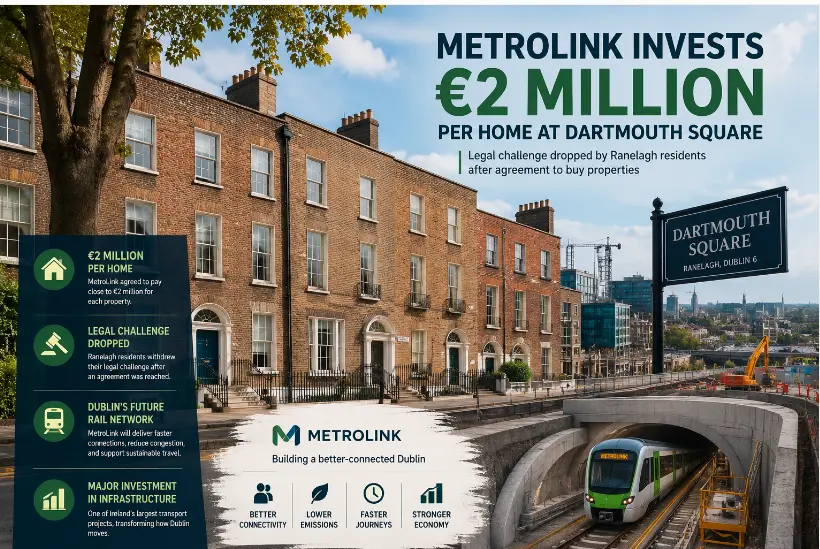
By The MetroLink Dartmouth Square houses acquisition has become one of the most talked-about aspects of Ireland’s largest public transport project. MetroLink reportedly spent close to €2 million per home to purchase several historic properties at Dartmouth Square in Dublin after reaching an agreement with local homeowners. The agreement also brought an end to a legal challenge launched by Ranelagh residents, allowing the transport project to move forward.
While the purchase price has attracted widespread attention, transport planners argue that acquiring the properties was necessary to deliver one of Ireland’s most significant infrastructure investments. The development highlights the balance governments must strike between improving public transport and protecting established communities.
This article explains why MetroLink purchased these homes, why the legal challenge ended, and what the decision means for Dublin’s future transport network.
What Is MetroLink?
MetroLink is a planned high-capacity railway connecting north and south Dublin through a modern underground and above-ground transport system. The project aims to improve public transport by linking Dublin city centre with key destinations, including Dublin Airport, residential suburbs, business districts, and educational institutions.
The railway is expected to reduce travel times, decrease road congestion, and encourage greater use of sustainable public transport. According to transport planners, MetroLink will significantly increase passenger capacity while supporting Dublin’s long-term population growth.
Major infrastructure projects of this scale often require land acquisition, utility relocation, and extensive engineering work before construction begins.
Why Did MetroLink Purchase Dartmouth Square Houses?
The MetroLink Dartmouth Square houses became essential because engineers identified the area as necessary for construction activities associated with the underground railway.
Infrastructure projects involving tunnels frequently require temporary access sites, ventilation structures, construction compounds, or engineering facilities. In some cases, purchasing nearby properties becomes more practical than attempting to build around existing buildings.
Although spending nearly €2 million per property appears substantial, several factors contributed to the overall cost.
These include:
- Dublin’s high property values.
- Compensation for homeowners.
- Legal and acquisition costs.
- The strategic importance of the location.
- Project-related planning requirements.
Government infrastructure projects generally compensate property owners based on market value together with additional statutory considerations where applicable.
Understanding the Legal Challenge
Before the purchases were completed, several Ranelagh residents challenged aspects of the MetroLink project through legal proceedings.
Their concerns reportedly focused on the project’s potential impact on residential properties, construction activities, local amenities, and the surrounding neighbourhood.
Legal challenges are relatively common during large infrastructure developments because affected residents seek clarity regarding environmental impacts, compensation, construction timelines, and property rights.
However, the legal proceedings were eventually withdrawn after an agreement was reached regarding the purchase of the Dartmouth Square homes.
Ending the legal dispute removed one of the significant obstacles facing the project’s progress.
Why Property Acquisition Is Sometimes Necessary
Large railway projects across Europe often require governments to acquire private property.
Examples from cities such as London, Paris, Copenhagen, and Madrid demonstrate that underground rail systems frequently involve purchasing homes or commercial buildings to facilitate construction.
Although these acquisitions can be controversial, they are generally undertaken only when alternative engineering solutions are either technically impractical or considerably more expensive.
In the case of the MetroLink Dartmouth Square houses, planners concluded that purchasing the properties would support efficient construction while helping avoid greater engineering risks.
The Cost Behind Major Infrastructure Projects
The reported €2 million per home figure has generated public discussion about infrastructure spending.
However, experts note that the purchase price represents only a small portion of MetroLink’s total investment.
Major transport projects involve significant expenditure across multiple areas, including:
- Tunnel excavation.
- Railway stations.
- Track installation.
- Safety systems.
- Power infrastructure.
- Environmental protection.
- Land acquisition.
- Engineering design.
International experience shows that underground rail construction is among the most expensive forms of public infrastructure because of its engineering complexity and strict safety standards.
Benefits MetroLink Could Deliver
Supporters argue that the MetroLink project will provide long-term economic and environmental benefits that extend well beyond its construction costs.
Improved public transport has been shown in many cities to reduce traffic congestion, lower vehicle emissions, and improve access to employment opportunities.
Potential advantages include:
- Faster airport connections.
- Reduced dependence on private vehicles.
- Lower greenhouse gas emissions.
- Increased public transport capacity.
- Better connectivity between communities.
- Improved economic productivity.
Research by international transport organisations consistently shows that efficient metro systems can increase accessibility while supporting sustainable urban development.
Concerns Raised by Local Communities
Despite the expected transport benefits, residents living near major construction sites often experience understandable concerns.
These may include:
- Construction noise.
- Temporary road closures.
- Property impacts.
- Dust and vibration.
- Changes to neighbourhood character.
Governments typically address these concerns through environmental assessments, public consultations, compensation arrangements, and ongoing community engagement.
The agreement reached with homeowners at Dartmouth Square demonstrates how negotiation can sometimes resolve disputes without prolonged court proceedings.
What the Agreement Means for MetroLink
The resolution of the legal challenge provides greater certainty for the MetroLink project.
Removing legal obstacles allows planners to continue detailed design work, procurement activities, and preparation for future construction phases.
While additional planning and regulatory approvals remain important parts of any major infrastructure project, resolving property disputes helps reduce uncertainty and improves project timelines.
For Dublin residents, the agreement represents another step toward delivering a transport system intended to serve future generations.
The Wider Importance of MetroLink
As Dublin continues to grow, demand for reliable public transport is expected to increase significantly.
Population growth, expanding employment centres, and environmental targets all place additional pressure on existing transport networks.
Modern metro systems have transformed mobility in cities around the world by providing fast, frequent, and dependable public transport.
Supporters believe MetroLink can play a similar role in Dublin by creating stronger connections between communities while supporting economic development and climate goals.
Although debates surrounding property acquisitions and project costs are likely to continue, the broader objective remains the creation of a modern transport network capable of meeting future demand.
Conclusion
The acquisition of the MetroLink Dartmouth Square houses has become one of the defining stories surrounding Dublin’s ambitious rail project. Spending approximately €2 million per property has attracted public attention, but the purchases also helped resolve a legal challenge brought by Ranelagh residents and cleared an important hurdle for project progress.
Major infrastructure developments inevitably involve difficult decisions, particularly when private property is affected. However, transport experts argue that strategic land acquisition is sometimes necessary to deliver projects that benefit millions of future passengers.
As MetroLink moves closer to construction, the agreement at Dartmouth Square illustrates both the complexity of urban infrastructure planning and the importance of balancing community interests with long-term public investment. The coming years will determine how this landmark railway reshapes transport, connectivity, and sustainable mobility across Dublin.