 By
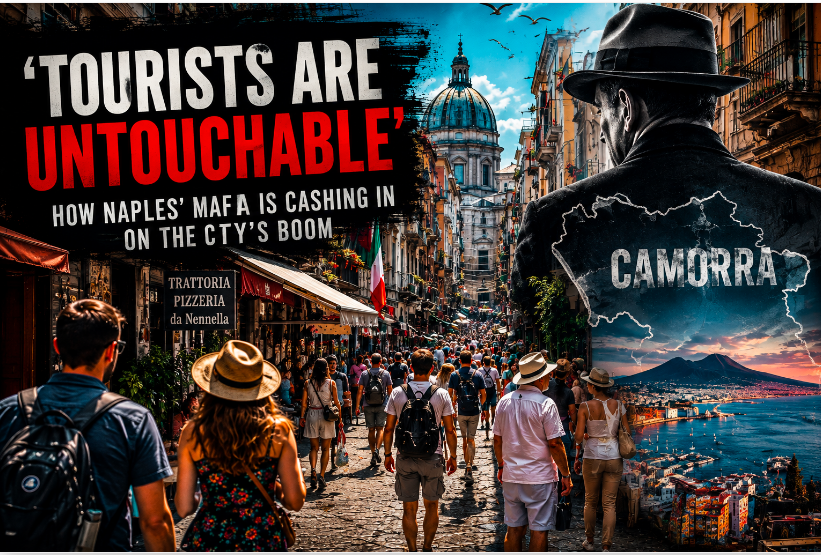
By Naples has changed dramatically in recent years. The southern Italian city, once often associated with poverty, organized crime and urban decline, has become one of Europe’s most popular tourist destinations.
Visitors now fill the historic centre, explore the Spanish Quarter, eat traditional Neapolitan pizza and use Naples as a base for trips to Pompeii, Capri and the Amalfi Coast.
The tourism boom has brought jobs, new businesses and investment. But it has also created another opportunity: money.
For the Camorra, Naples’ traditional mafia network, tourism offers access to legitimate businesses and fast-growing markets. Italian investigators have repeatedly warned that organized crime groups are increasingly interested in apparently legal economic activities rather than relying only on traditional criminal businesses.
This does not mean tourists are generally being targeted by the mafia. In fact, the idea behind the phrase “tourists are untouchable” is that visitors represent valuable customers. Criminal groups can potentially make more money from the businesses surrounding tourism than from directly attacking tourists.
Why Tourism Is So Attractive to Organized Crime
Tourism creates demand for a huge range of services.
Hotels, restaurants, bars, holiday apartments, transport companies, property businesses, beach facilities and entertainment venues can all generate significant revenue.
That makes the tourism economy attractive to criminal organizations looking to invest or launder money.
Investigators have described a modern form of the Camorra that can be less visible than the traditional image of armed gangs controlling streets. Instead, organized crime can seek influence through companies, investments, contracts, property and commercial activity.
A 2024 report based on statements from Italy’s Anti-Mafia Investigation Directorate warned that the tourism boom in Naples was among the economic areas attracting Camorra attention. Authorities said organized crime was increasingly looking toward apparently clean businesses and legal economic channels.
The strategy can be simple: illegal profits enter legitimate businesses, while the business itself generates additional legal-looking income.
Restaurants and Hospitality Under the Spotlight
Restaurants are especially important in Naples because food is one of the city’s biggest attractions.
Neapolitan pizza, cafés, bars and restaurants are central to the visitor experience. The historic centre has seen a large increase in tourism-related activity, creating intense competition for valuable commercial space.
That economic growth can also make restaurants attractive targets for criminal infiltration.
Authorities have previously seized businesses in Naples where investigators alleged connections between commercial activity and mafia clans. In one high-profile case, a famous Naples pizzeria was seized amid allegations that it was controlled by the Contini clan.
Such cases do not mean that ordinary restaurants in Naples are controlled by organized crime. Most businesses are legitimate. The concern is that criminal groups can attempt to use individual companies as vehicles for investment, money laundering or influence.
Property Is Another Major Prize
The transformation of Naples has also increased interest in property.
Historic apartments and buildings can be converted into holiday rentals, guesthouses, hotels and other tourist accommodation. Rising demand can make property a highly valuable asset.
For organized crime, property has another attraction: it can provide a way to store and move wealth.
Italian anti-mafia authorities have repeatedly targeted suspicious assets and companies connected to criminal organizations. In June 2026, the Prefecture of Naples announced seven new anti-mafia measures involving businesses operating across sectors including restaurants, real estate, marketing, advertising, clothing and construction.
The breadth of those sectors shows why the problem cannot simply be described as a “mafia tourism” issue. Organized crime can spread across many parts of the local economy.
The Parking Business Shows How Small Markets Can Become Big Money
Tourism is also connected to less glamorous businesses.
Parking is one example.
In April 2025, Italian police arrested 24 people suspected of involvement with Camorra clans in a case involving an illegal parking protection racket in Naples. Authorities alleged that unauthorized parking attendants collected money from drivers and that some paid protection money to organized crime groups.
Reports estimated that thousands of unauthorized parking attendants in Naples could generate more than €100 million a year.
For visitors, a small parking payment might seem insignificant. At city scale, however, thousands of small payments can become a major source of revenue.
This illustrates an important feature of organized crime: it does not always need to control an entire industry. Controlling access to profitable spaces or services can be enough.
The Camorra Is Not a Single Mafia Organization
One important fact is often lost in discussions about the Naples mafia.
The Camorra is not a single organization with one boss controlling every criminal activity across Naples.
It consists of multiple clans and groups that can cooperate, compete or fight over territory and markets.
That makes the criminal landscape complicated.
Recent investigations show that authorities continue to pursue different Camorra groups for alleged extortion, money laundering, drug trafficking, illegal gambling and the use of businesses to support criminal activity.
In July 2026, the Direzione Investigativa Antimafia announced an operation involving 22 people suspected of belonging to a Camorra organization linked to the Casalesi faction. Investigators alleged crimes including mafia association, fictitious ownership of assets, money laundering, extortion and illegal gambling.
The case is significant because it demonstrates how organized crime can combine traditional criminal activities with commercial businesses.
Why Tourists May Not Be the Main Target
The phrase “tourists are untouchable” should not be interpreted literally.
Tourists can still become victims of ordinary crimes such as theft, scams and robbery. Naples, like many major European tourist cities, faces these problems.
But organized crime has a different incentive.
A tourist spending €20 on dinner, €100 on accommodation or hundreds of euros on a holiday can represent revenue for local businesses. Attacking tourists directly would damage the wider tourism economy.
The more profitable strategy for organized crime can therefore be to make money around tourism rather than from tourists themselves.
This distinction matters.
The danger is not necessarily a visitor walking through Naples and encountering a mafia boss. The greater concern is the hidden economic influence that can develop behind businesses, property and services.
Naples Is Fighting Back
Italian authorities are not ignoring the threat.
The Prefecture of Naples has continued using anti-mafia measures to block companies considered vulnerable to organized-crime infiltration. The Direzione Investigativa Antimafia is also carrying out financial investigations and asset seizures against suspected criminal networks.
The government has also sought to reclaim property once associated with organized crime.
In May 2026, Italy’s Interior Ministry announced the demolition of Palazzo Fienga in Torre Annunziata, a building confiscated from the Camorra. The site is planned to become a public “piazza della legalità,” turning a symbol of criminal power into a community space.
These actions highlight an important point: Naples’ tourism boom does not belong to the mafia.
It belongs to the city, its residents and legitimate businesses.
The Future of Naples’ Tourism Economy
Naples is unlikely to turn away from tourism. The city’s history, food, culture and location make it an increasingly attractive destination.
The challenge is ensuring that the money generated by visitors reaches legitimate businesses and local communities instead of being captured by criminal networks.
That means stronger financial checks, transparent property ownership, effective policing and close monitoring of businesses vulnerable to organized-crime infiltration.
For tourists, Naples remains a fascinating destination with enormous cultural value. The presence of the Camorra is a serious social and economic issue, but it should not define the entire city.
The real story is more complicated.
Naples is experiencing a tourism boom, and organized crime wants a share of the money that comes with it. The fight is increasingly taking place not only in the streets, but inside the economy itself.