 By
By Payday Loans in Ireland: 5 Important Facts to Know Before Borrowing
Payday loans are generally associated with short-term borrowing intended to cover an immediate financial need. However, the cost of this type of credit can be significantly higher than many standard borrowing options.
Students looking for ways to manage education-related expenses can also learn more about [student loans in Ireland], including available funding options and important borrowing considerations.
In Ireland, consumers may encounter the term high-cost credit rather than payday loans. The Central Bank of Ireland regulates high-cost credit providers, while the Competition and Consumer Protection Commission (CCPC) provides information about the costs, rules and risks associated with this type of borrowing.
Understanding how these loans work, what APR means and what alternatives may exist can help consumers make more informed financial decisions.
Important: This article is for general information and does not recommend taking out a payday loan or any particular financial product.
What Are Payday Loans?
Payday loans are typically short-term loans associated with relatively small amounts of borrowing and high borrowing costs.
The name comes from the idea that a borrower may use the money to cover expenses until their next payday. In practice, products and repayment arrangements vary between providers and countries.
In Ireland, similar products are generally discussed within the high-cost credit sector. The Central Bank explains that high-cost credit agreements usually involve credit where the total cost exceeds an APR of 23%, subject to the legal definition and applicable rules.
The Central Bank also states that high-cost credit providers must be authorised. Operating as a high-cost credit provider without the required authorisation is an offence.
This distinction is important for anyone searching online for payday loans Ireland, because terminology used on international websites may not accurately describe the Irish lending market.
5 Important Facts About Payday Loans
1. Payday Loans Can Be High-Cost Credit
One of the most important things to understand about payday loans is that short repayment periods do not necessarily mean low costs.
The Central Bank describes high-cost credit providers as offering small loans over short periods at high interest rates. It also states that high-cost credit can be one of the most expensive ways to borrow money.
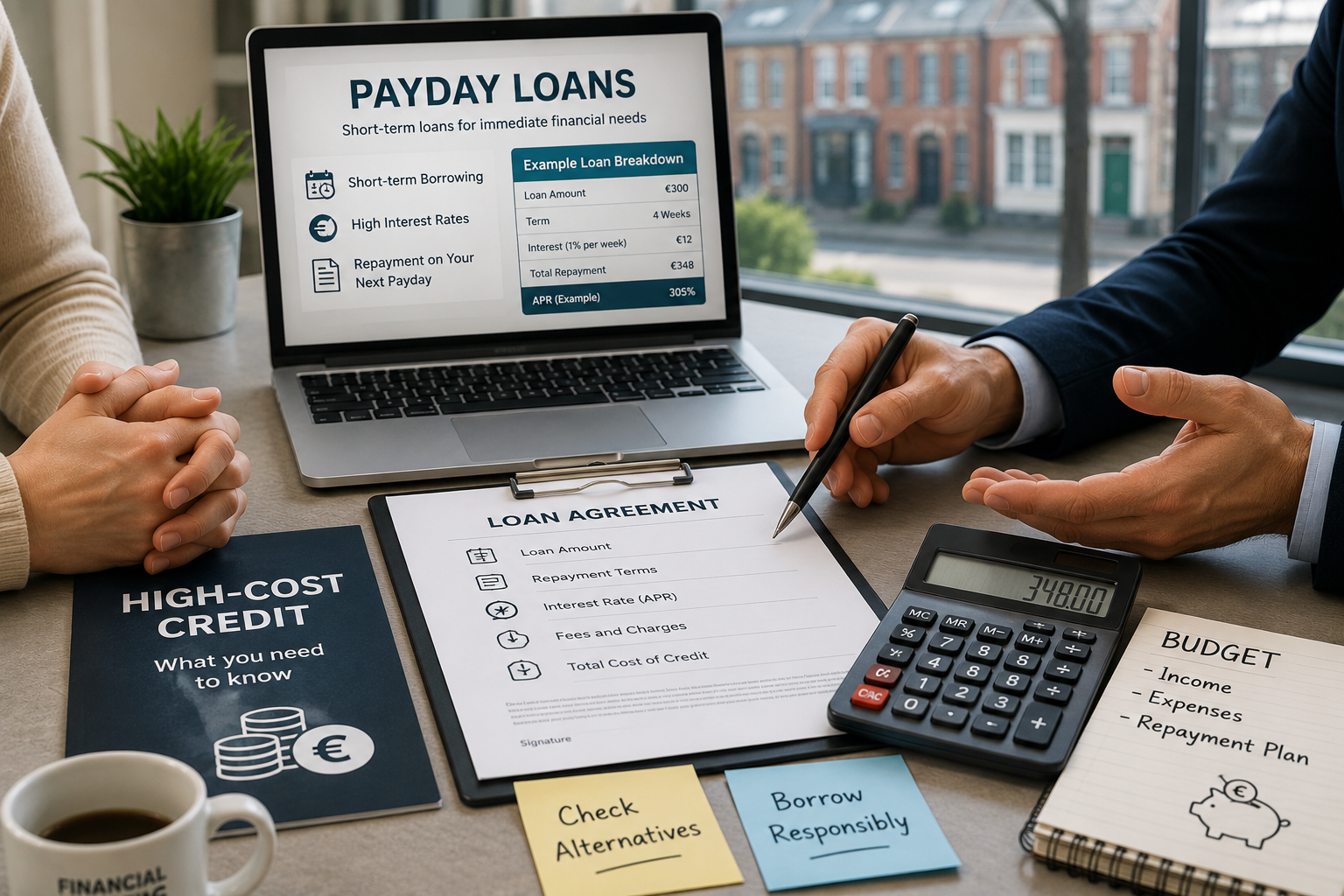
In Ireland, the Central Bank’s rules include an interest-rate cap for high-cost credit agreements of 1% per week simple interest on fixed-rate loans, up to a maximum of 48%, subject to the applicable legislation.
However, the APR shown for a short-term loan can look considerably higher because APR expresses the cost on an annualised basis.
That is why looking only at the advertised weekly or periodic interest rate can give an incomplete picture.
2. APR Is Important When Comparing Borrowing Costs
APR, or Annual Percentage Rate, is one of the key figures consumers should understand when considering borrowing.
The CCPC explains that APR takes account of the interest rate, loan term and certain fees, allowing consumers to compare loans of the same amount and term. For loans with different terms, the CCPC recommends looking at the cost of credit as well.
For example, a short-term loan can have a relatively small repayment amount each week while still having a high overall cost compared with the amount originally borrowed.
The total cost of credit provides a clearer picture because it shows how much extra is paid above the original amount borrowed.
3. Short-Term Borrowing Can Still Create Financial Pressure
The short repayment period associated with payday loans can make the repayment schedule an important consideration.
A borrower needs to consider whether the required repayments are affordable alongside normal household expenses and existing financial commitments.
The CCPC recommends considering affordability, APR and the total cost of credit before taking out a loan.
It is also important to remember that a short-term loan does not automatically solve an underlying financial problem. If borrowing is repeatedly needed to cover ordinary expenses, it may be a sign that a broader budget or debt-management review is needed.
4. Check Whether a High-Cost Credit Provider Is Authorised
When researching payday loans in Ireland, checking the provider’s regulatory status is an important consumer-protection step.
The Central Bank maintains a register of authorised high-cost credit providers. Consumers can use the register to check whether a provider is authorised to operate in this sector.
The Central Bank also warns consumers that regulated high-cost credit providers cannot charge administration fees to apply for a loan or require an upfront fee before providing a loan.
This is particularly important because financial scams can sometimes imitate legitimate lending services.
If a website or person asks for an upfront payment simply to release a loan, consumers should be extremely cautious and verify the provider independently.
5. Other Borrowing Options May Cost Less
Before considering payday loans, it can be useful to understand whether another form of borrowing or financial support is more suitable.
The CCPC notes that personal loans are available from banks, building societies, finance companies and credit unions, with rates and terms varying between providers.
Credit unions can also offer smaller loans, depending on their individual lending criteria.
Ireland also has the It Makes Sense Loan Scheme, designed to provide lower-cost borrowing to eligible people receiving social welfare payments. The CCPC states that these loans range from €100 to €2,000, with a maximum interest rate of 12% or 12.68% APR, subject to the scheme’s conditions.
The existence of alternatives does not mean that every option will be suitable for every person. The important point is to compare the total cost and repayment commitment rather than choosing a loan simply because it appears quick or convenient.
How Much Do High-Cost Loans Cost?
The cost of payday loans or other high-cost credit products depends on the specific agreement.
The Central Bank explains that the interest-rate rules for high-cost credit include a maximum simple interest rate of 1% per week for fixed-rate loans, subject to a 48% maximum.
For reliable information about high-cost credit and borrowing in Ireland, readers can visit the [Competition and Consumer Protection Commission (CCPC)] for independent consumer guidance.
However, the APR associated with short-term lending can appear much higher because of the way annualised rates are calculated.
For example, the Central Bank’s register currently shows authorised providers with different permitted rates, terms and maximum APRs. This demonstrates why consumers should examine the specific agreement rather than relying on a general figure for all high-cost loans.
The most useful figures to compare include:
- amount borrowed
- repayment amount
- number of repayments
- APR
- total amount repayable
- total cost of credit
- any applicable fees or charges
What Is the Difference Between Payday Loans and Personal Loans?
The terminology can vary between countries, but the main difference is usually the cost, term and structure of the borrowing.
Traditional personal loans in Ireland are often available over longer periods and may have substantially lower interest rates than high-cost credit. The CCPC says personal loans commonly range from €2,500 to €25,000 and are usually repaid over several years, although terms vary.
By contrast, high-cost credit generally involves smaller amounts and shorter repayment periods.
A longer loan term can reduce the regular repayment amount but may increase the total interest paid. Therefore, borrowers should compare the overall cost, not just the monthly or weekly payment.
What Happens If Someone Struggles to Repay?
Financial difficulties can make any form of borrowing harder to manage.
The CCPC states that if a consumer cannot afford to repay a high-cost credit loan, they should contact the provider as soon as possible. Under the applicable rules, high-cost credit providers cannot charge additional fees or penalties when a borrower misses payments.
The CCPC also points consumers towards the Money Advice and Budgeting Service (MABS) for free, confidential support if they are struggling with debt.
Getting help early can be more useful than waiting until financial problems become more difficult to manage.
Payday Loans and Credit History
Borrowing decisions can also have implications for a person’s wider financial record.
Ireland does not use one universal credit score in the same way some other countries do. The CCPC explains that lenders consider a person’s credit history, including information about previous borrowing and repayment behaviour.
The Central Credit Register records information on loans of €500 or more.
This is another reason to think carefully before taking on additional borrowing and to make sure repayments are manageable.
How to Compare Loan Costs
When comparing payday loans Ireland consumers should avoid looking only at the headline interest rate.
The CCPC recommends considering APR and the total cost of credit. For loans with different terms, comparing the total amount repayable can be particularly useful.
A loan with a lower weekly payment is not necessarily cheaper if it lasts much longer.
Similarly, a loan with a seemingly low periodic interest rate can still have a high annualised cost.
Understanding the complete repayment figure can therefore provide a clearer basis for comparison.
Frequently Asked Questions About Payday Loans
What are payday loans?
Payday loans are generally short-term borrowing products associated with relatively small amounts and high borrowing costs. In Ireland, similar products are generally covered by the regulatory framework for high-cost credit.
Are payday loans legal in Ireland?
High-cost credit lending is legal when provided by an appropriately authorised provider operating within the applicable rules. The Central Bank maintains a register of authorised high-cost credit providers.
Are payday loans expensive?
They can be. The Central Bank describes high-cost credit as one of the more expensive ways to borrow money, so consumers should compare APR and the total cost of credit carefully.
What is APR?
APR stands for Annual Percentage Rate. It reflects the annualised cost of borrowing and incorporates certain interest and fees. The CCPC recommends using APR when comparing loans of the same amount and term.
Are there alternatives to payday loans in Ireland?
Depending on individual circumstances, alternatives may include personal loans, credit union borrowing or eligible lower-cost schemes such as the It Makes Sense Loan Scheme.
Where can I check whether a lender is authorised?
The Central Bank of Ireland provides a register of high-cost credit providers. Checking the provider’s regulatory status is an important consumer-protection step.
Final Thoughts on Payday Loans
Payday loans can appear attractive because they are associated with short-term borrowing, but the cost of high-cost credit can be significant.
For consumers in Ireland, understanding the distinction between the everyday term “payday loan” and the regulated category of high-cost credit is important.
Before considering any borrowing, look beyond the amount you can receive. Check the APR, total cost of credit, repayment schedule and any fees. It is also important to verify that a lender is authorised and to consider whether a lower-cost alternative may be available.
The CCPC and Central Bank of Ireland provide reliable information about borrowing, high-cost credit and consumer protection, making them useful starting points when researching financial decisions.