 By
By Edinburgh Airport Suspends All Flights After IT Issue — What It Means & What You Should Know
📌 Key Facts — What Happened Today
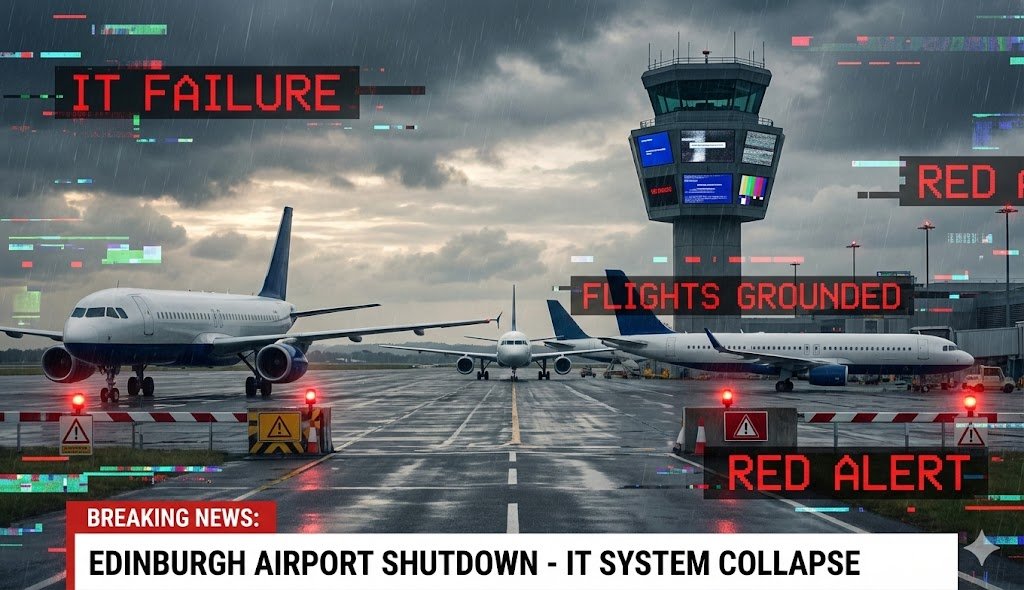
Edinburgh Airport has announced a complete suspension of all flights, affecting both arrivals and departures, due to an IT issue impacting its air traffic control provider.
The airport confirmed that:
- All flights are temporarily grounded.
- Technical teams are currently investigating and working to restore systems.
- Passengers are urged to contact their airlines for real-time updates.
- There is no confirmed time for when operations will resume.
This sudden shutdown has created widespread disruption, affecting thousands of passengers, multiple airlines, connecting flights, and regional travel plans.
🧑✈️ Why an Air Traffic Control IT Issue Grounds All Flights
Air traffic control (ATC) systems are the backbone of safe aviation. Even a minor glitch in these systems can lead to major safety concerns.
🔍 What Air Traffic Control Systems Manage
| ATC Function | Why Failure Causes Shutdown |
|---|---|
| Flight routing and spacing | Loss of system data means aircraft cannot be guided safely. |
| Radar tracking and aircraft identification | Aircraft may become untrackable, risking unsafe flight zones. |
| Communication with pilots | Without clear communication, aircraft cannot legally take off or land. |
| Runway and taxi management | Risk of runway congestion or collision increases drastically. |
| Coordination with other airports | Breaks the flow of airspace management, causing wider disruption. |
Because ATC involvement is legally required for safe operations, any technical issue = immediate ground stop until full safety is restored.
🌍 Impact Assessment — Who Is Affected?
The shutdown touches every part of the travel ecosystem.
🚶 Passengers
- Cancelled or significantly delayed flights
- Missed connections
- Rebooking complications
- Increased travel costs and need for overnight stays
- Stress, uncertainty, and long wait times
✈️ Airlines
- Out-of-position aircraft
- Crew scheduling disruption
- Breakdowns in flight rotations
- Customer service overload
- Financial losses from cancellations
🛄 Edinburgh Airport Operations
- Ground-based congestion
- Overwhelmed customer service desks
- Baggage build-up
- Strained support services
🧳 Connecting Travellers
- Interrupted multi-leg trips
- Missed international connections
- Forced rerouting or accommodation needs
🚗 Local Economy
- Hotels face sudden demand spikes
- Taxi and private hire availability drops
- Bus and rail services handle more traffic
- Local businesses near the airport see unusual footfall
✍️ Official Messaging & Immediate Actions Taken
The airport’s internal communications outline:
- A full operational halt
- Continued work by technical teams
- Indefinite suspension period
- Guidance urging passengers to avoid the airport unless advised otherwise
- Recommendation to contact airlines for updates
Airport staff remain active, preparing for system recovery and coordinating with airlines for passenger support.
🛫 Lessons From Previous ATC Disruptions
Air traffic control failures — although rare — are recognized as one of the most disruptive events in aviation. History shows that:
- A single ATC system failure can ground thousands of flights within hours.
- Even short outages cause long backlogs that take many hours (or days) to clear.
- Airlines and airports face multi-day ripple effects due to aircraft displacement.
- Passenger rights and obligations often become a major discussion point afterward.
Edinburgh Airport has experienced ATC challenges before, along with other UK airports, which highlights the ongoing vulnerability of centralized air traffic systems.
🎯 Passenger Action Plan — What You Should Do Right Now
If your flight is affected, follow this structured plan:
✔ Step 1: Check Airline Notifications
Airlines will communicate faster than airports during disruptions.
✔ Step 2: Do Not Travel to the Airport Unless Advised
This prevents overcrowding and helps support smooth operations once flights resume.
✔ Step 3: Request Rebooking or Refund
You can typically choose between:
- Free rebooking
- Full refund
- Alternative flight routes (if available)
✔ Step 4: Keep Receipts for All Expenses
Accommodation, meals, transport — these may be claimable later.
✔ Step 5: Monitor Updates Regularly
Systems may come back online suddenly, and flights might be rescheduled quickly.
✔ Step 6: Allow Flexibility for Connecting Flights
If traveling internationally or long-haul, check for delayed onward travel.
✔ Step 7: Contact Travel Insurance Providers
Many policies cover delays due to ATC issues.
⚠️ Understanding Your Passenger Rights
When flights are disrupted due to air traffic control issues:
- Airlines must provide care and assistance (meals, accommodation, rebooking).
- Airlines may not owe cash compensation, because ATC failures are often considered “extraordinary circumstances.”
- Passengers still retain the right to a refund or alternative flight if the original flight is cancelled.
- Overnight delays often require airlines to arrange or reimburse hotels and meals.
Always keep receipts and ask airline support teams for clarity.
🧮 What Happens Next? Short-Term vs. Extended Disruption
The duration of the outage determines the severity of impact.
📊 Scenario Table
| Scenario | Short Outage (Resolved Quickly) | Long Outage (Several Hours or Full Day) |
|---|---|---|
| Flight operations | Limited delays; flights resume same day | Large-scale cancellations; multi-day ripple |
| Passenger impact | Mild inconvenience | Stranded passengers; hotel stays required |
| Airline operations | Manageable rebooking | Crew/aircraft displacement; high delays |
| Airport congestion | Minimal | Severe crowding and baggage backlog |
| Financial effect | Small | Significant losses for airlines & services |
| Industry response | Standard review | Possible regulatory investigation |
📚 Why ATC Failures Occur — Common Causes
Air traffic control failures usually stem from one or more of the following:
🖥️ 1. Software Bugs
ATC relies heavily on synchronized digital systems. A small bug can crash essential processes.
⚙️ 2. Hardware Malfunction
Servers, radar units, or communication devices can break unexpectedly.
👷 3. Human Error
Misconfigurations during updates or maintenance can temporarily cripple ATC interfaces.
🔌 4. Power or Network Outage
Redundancy exists, but major failures can bypass backup systems.
🌐 5. System Overload
Unusual traffic volume or unexpected spikes can disrupt performance.
🔐 6. Cybersecurity Complications
Although rare, vulnerabilities or security countermeasures can create system instability.
🧩 7. Aging Infrastructure
Legacy systems, if not modernized, carry higher risk of failure.
The combination of high complexity and strict safety rules means that any failure triggers immediate grounding.
🧭 Broader Implications for UK & European Air Travel
This incident raises major questions for aviation infrastructure:
🛑 1. Single-Point Failure Risks
Modern aviation relies on centralized systems. A single IT failure can halt operations across entire regions.
🛑 2. Need for ATC Modernization
Airports may face pressure to invest in more robust, redundant systems.
🛑 3. Passenger Confidence
Frequent disruptions reduce trust in airline reliability.
🛑 4. Economic Effects
Travel, tourism, and regional business all suffer significant losses from shutdowns.
🛑 5. Regulatory Pressure
Expect stronger oversight and audits into ATC infrastructure.
🛑 6. Operational Backlogs
Even after recovery, flight schedules can remain messy for 24–72 hours.
⚙️ What Airlines, Airports & Regulators Should Improve
✔ Build Redundant ATC Systems
Multiple independent backups to prevent total shutdowns.
✔ Enhance Maintenance & Monitoring
Predictive maintenance can detect issues before failure.
✔ Improve Passenger Communication
Clear updates reduce frustration during uncertainty.
✔ Strengthen Contingency Planning
Coordination between airports, airlines, and ATC must be seamless.
✔ Stress-Test IT Infrastructure
Simulated failures help ensure systems remain stable under pressure.
What Travelers Can Learn — Smarter Planning For the Future
This event highlights several best practices:
- Choose refundable fares when possible.
- Get travel insurance that covers operational disruptions.
- Avoid tight layovers or same-day event plans.
- Stay subscribed to airline notifications.
- Travel with essential items in hand luggage.
- Keep backup travel plans — alternate airports, routes, times.
Summary — What We Know So Far
- Edinburgh Airport has suspended all flights due to an IT issue affecting air traffic control systems.
- There is no set timeline for resumption.
- The disruption affects thousands of passengers, airlines, airport staff, and the wider travel network.
- Passenger rights for assistance remain intact, even if compensation may not apply.
- This incident highlights the vulnerability of aviation networks to IT failures and the importance of robust air traffic infrastructure.