 By
By Communist Party of Ireland Reports €217,967 Income from Rentals and Merchandise Sales
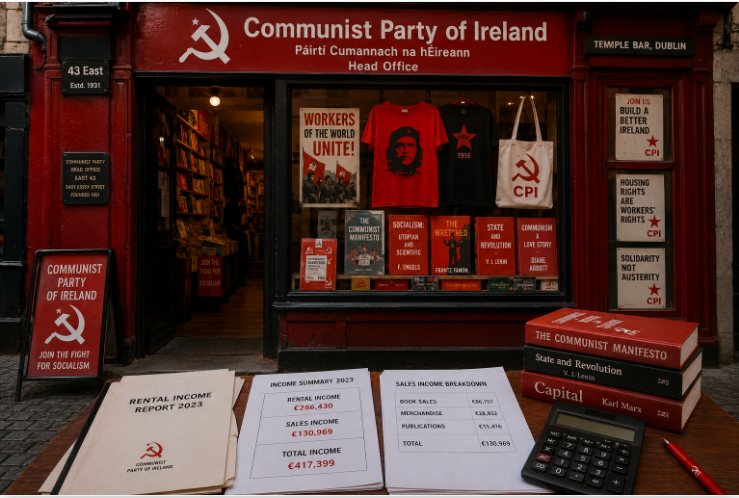
The Communist Party of Ireland (CPI) has reported total income of €217,967 for the last financial year, according to financial accounts submitted to the Standards in Public Office Commission (SIPO). The figures reveal that the party generated most of its revenue from rental income, alongside earnings from book and merchandise sales, highlighting a funding model that differs from many political parties that rely heavily on donations or membership fees.
Based in Temple Bar, Dublin, the Communist Party of Ireland remains one of the country’s smaller political organizations. While it has a limited electoral presence, the latest financial disclosures show that the party maintains a stable income through its property assets and publishing activities.
The annual accounts provide greater transparency into how the party finances its operations and comply with Ireland’s political finance rules, which require registered political parties to submit financial statements to SIPO.
What the Latest Financial Accounts Reveal
According to the accounts filed with the Standards in Public Office Commission, the Communist Party of Ireland generated €217,967 during the financial year.
The reported income came primarily from:
- Rental income from property assets.
- Sales of political books and publications.
- Merchandise linked to the party’s activities.
Unlike larger political parties that often receive significant donations, fundraising contributions, or state funding, the CPI’s financial structure demonstrates greater reliance on internally generated revenue.
The disclosure offers an insight into how smaller political organizations in Ireland sustain their operations while complying with financial reporting regulations.
Understanding the Communist Party of Ireland
The Communist Party of Ireland is a Marxist-Leninist political party that advocates socialist economic policies, workers’ rights, public ownership of key industries, and social equality.
Founded in its current form during the 1970s, the party participates in political campaigns, educational activities, publications, and trade union movements rather than maintaining a large parliamentary presence.
Its headquarters in Temple Bar, Dublin, also serve as an administrative and organizational base for many of its activities.
Although relatively small compared with Ireland’s major political parties, the CPI continues to contribute to political debate on issues including housing, healthcare, employment rights, international affairs, and economic policy.
Why Rental Income Matters
One of the most notable aspects of the CPI’s financial report is the importance of rental income.
Many political organizations rely on:
- Membership subscriptions.
- Individual donations.
- Public funding.
- Fundraising events.
However, the Communist Party of Ireland has developed an additional source of financial stability through property ownership that generates recurring rental income.
Rental revenue provides predictable cash flow that can help cover operational expenses regardless of election cycles or fundraising performance.
For smaller political parties, diversified income sources may reduce financial uncertainty and improve long-term sustainability.
Book and Merchandise Sales Continue to Generate Revenue
The accounts also show income generated through the sale of books and merchandise.
Political publications remain an important way for parties to communicate their ideas, historical perspectives, and policy positions.
Books often include:
- Political analysis.
- Historical publications.
- Educational materials.
- Party literature.
- Ideological works.
Merchandise may include clothing, badges, posters, flags, and promotional items supporting party activities.
Although merchandise sales generally represent a smaller share of overall revenue than rental income, they contribute additional financial support while increasing public engagement.
The Role of the Standards in Public Office Commission (SIPO)
The Standards in Public Office Commission (SIPO) plays a key role in maintaining transparency within Ireland’s political system.
Political parties registered in Ireland are required to submit financial statements that outline their income, expenditure, and financial position.
These reporting requirements help:
- Improve public accountability.
- Increase transparency.
- Monitor political financing.
- Support confidence in democratic institutions.
Financial disclosures enable voters, researchers, journalists, and regulators to better understand how political organizations fund their activities.
Political Party Funding in Ireland
Political funding varies significantly between parties.
Large political parties often receive income from multiple sources, including state funding based on electoral performance, donations, membership fees, fundraising events, and contributions from elected representatives.
Smaller parties, however, frequently rely on alternative funding methods to maintain operations.
The Communist Party of Ireland’s latest accounts illustrate how property income and publishing activities can provide financial support outside traditional fundraising models.
This diversity of funding demonstrates that political organizations may adopt different financial strategies depending on their size, membership, and organizational structure.
Why Financial Transparency Is Important
Transparency remains one of the foundations of democratic governance.
Financial reporting allows the public to understand:
- Where political funding originates.
- How organizations generate revenue.
- Whether reporting requirements are being followed.
- The financial health of political parties.
Public confidence increases when political organizations publish accurate financial information through independent regulatory systems.
Ireland’s reporting framework aims to ensure consistency and accountability across registered political parties regardless of their size.
Facts About Political Party Finance in Ireland
All registered political parties must comply with financial reporting rules established under Irish law.
The Standards in Public Office Commission oversees political finance reporting and monitors compliance with disclosure requirements.
Political parties may receive income from several sources, including donations, membership fees, property income, publications, fundraising events, and state funding where applicable.
Transparency requirements are designed to strengthen public trust and ensure accountability within Ireland’s democratic system.
What These Financial Results Mean
The latest financial figures do not necessarily reflect political influence or electoral strength. Instead, they provide an overview of the party’s financial operations during the reporting period.
Generating €217,967 through rental income and merchandise demonstrates that the Communist Party of Ireland has established income streams capable of supporting administrative functions and ongoing activities.
For observers of Irish politics, these accounts offer useful insight into the financial management of one of the country’s smaller political organizations.
Conclusion
The Communist Party of Ireland reported €217,967 in total income during the last financial year, according to accounts filed with the Standards in Public Office Commission (SIPO). Most of the revenue came from rental income, with additional earnings generated through book and merchandise sales.
The financial disclosure highlights the importance of transparency in political financing while illustrating how smaller parties can diversify their revenue sources beyond traditional donations. As Ireland continues to strengthen accountability through financial reporting, these published accounts provide valuable information about the operation and sustainability of political organizations across the country.